
It Is Not Just Nostalgia, That Is the Easiest Cop-Out in the World
Every time someone says older games hit harder, there is always some brilliant creature waiting in the corner to go, “nah, that is just nostalgia.”
No, not always.
Sometimes nostalgia is real, sure. Sometimes people remember old stuff more fondly because they were younger, life was simpler, and they had fewer bills and less lower back pain. Fine. That happens. But people lean on that excuse way too hard because it saves them from admitting something obvious: a lot of older games genuinely had more impact.
Not better in every possible way. Let us not start worshipping the past like idiots. Older games could be unfair, stiff, ugly, confusing, and sometimes designed by what I can only assume were deeply bitter men living off cigarettes and hatred. But even with all that, a lot of them still hit harder than modern games do.
Why?
Because older games had less room to bullshit you.
They had less storage, less power, less fancy lighting, less cinematic nonsense, less voice acting, less “engagement strategy,” less monetization filth, and way less patience for wasting your time. They could not hide weak design under giant maps, update roadmaps, battle passes, and loot systems that feel like somebody spilled an MMO into a single-player game.
If an older game wanted your attention, it had to earn it properly. Fast.
That pressure mattered.
Modern games often feel like they assume your time already belongs to them. Older games knew they had to grab you, hit you, and leave a mark before you turned the console off and went to do something else. That alone changes everything.
Older Games Got to the Point Instead of Building a Whole Airport Around Themselves
Start a lot of older games and they just begin.
Logo. Menu. Music. Maybe a quick intro if they are feeling dramatic. Then you are in. The game knows what it is and gets on with it. It does not treat the first ten minutes like an onboarding seminar for a software suite.
Modern games, on the other hand, love wasting your time before the actual game even starts.
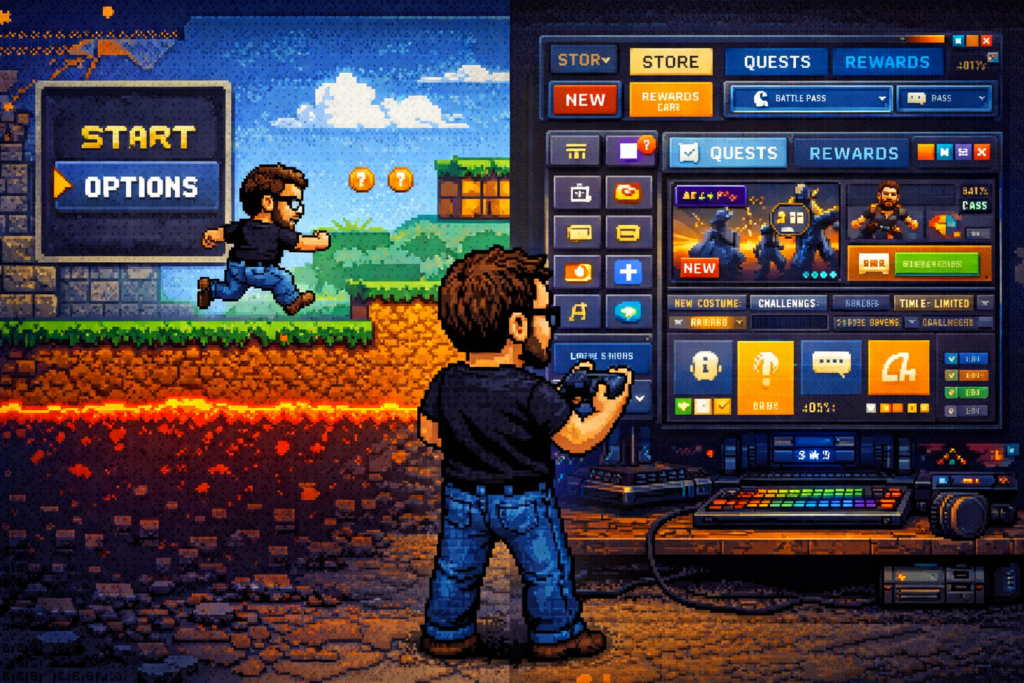
Now you boot something up and it feels like entering a shopping mall run by lawyers. Terms and conditions. account linking. update notice. server check. two launchers for some reason. news tab. store tab. premium edition content. seasonal banner. daily login nonsense. half the screen blinking like a slot machine having a nervous breakdown. Somewhere behind all that clutter there is supposedly an actual video game.
Older games did not have the luxury of that kind of nonsense. They had to make an impression early. Their first level had to work. Their first enemy had to matter. Their first five minutes needed to tell you, clearly, what kind of ride you were in for.
That is one of the things modern gaming lost: urgency.
Now people will defend games by saying, “it gets good after 12 hours.” Twelve hours? That is not a defense, that is an indictment. If your game needs the length of a work shift before it becomes interesting, then your pacing is broken. I do not care how many systems unlock later. A game should not feel like unpaid training.
Older games often understood that your time had weight.
They were built to make you care quickly, not trap you slowly.
The Challenge Felt More Real, Even When It Was Being a Bastard
Let me be fair here. Older games were not always “fair” in some clean, elegant, textbook way. Sometimes they were downright rude. Cheap deaths, weird checkpoints, awkward controls, enemies placed in ways that felt personal. Some older games absolutely had that “screw you specifically” energy.
But even then, the challenge often felt more honest.
A lot of older difficulty came down to learning. Learning the level. Learning the enemy pattern. Learning the jump timing. Learning the weapon recoil. Learning where the danger was coming from and adjusting instead of crying for a patch.
That lands differently than a lot of modern “difficulty,” which often feels less like challenge and more like paperwork.
Now difficulty gets buried under stats, perks, level scaling, gear scores, status effects, buffs, debuffs, crafting, rarity colors, and enough upgrade systems to make a tax form blush. You are not always overcoming the game. Sometimes you are just managing its clutter.
Older games often just looked at you and asked a much cleaner question: can you do this or not?
Can you beat this boss?
Can you survive this section?
Can you make this jump?
Can you figure out what the game wants from you without having your hand held like a nervous child on a field trip?
That kind of pressure leaves a stronger mark. When you finally beat something hard in an older game, it usually feels like you did it. Not your build. Not your gear score. Not your overpowered combo guide from some guy on YouTube. You.
That is why a short, nasty, well-designed fight in an older game can stay in your head for years. You remember the stress, the repetition, the pattern, the moment it clicked. Modern games often replace that with “progression,” but progression is not always satisfaction. Sometimes it is just activity dressed up as achievement.
Bigger numbers are not the same as stronger impact. Humans keep needing that explained, which is honestly exhausting.
Older Games Built Atmosphere Instead of Buying It in Bulk
This is where older games were absolute killers.
They did not have photorealistic visuals, performance capture, ultra-detailed environments, or enough processing power to render every bead of sweat on some gravel-voiced protagonist. So they had to make atmosphere the hard way.
- Sound.
- Silence.
- Music.
- Art direction.
- Weird level layouts.
- Limited visibility.
- Tension.
- Restraint.
And because they could not show everything, your brain had to fill in the gaps.
That made the experience stronger, not weaker.
A foggy street in an older horror game works not just because it hides technical limitations, but because it creates uncertainty. A dim corridor with awkward sounds and bad visibility can feel ten times more unsettling than some modern ultra-detailed hallway because the older game leaves room for your imagination to start doing its job.
And your imagination is usually meaner than any graphics engine.
That is something older games understood really well. Suggestion matters. Not seeing everything matters. Silence matters. Strange emptiness matters. Modern games often have the opposite problem. They over-explain. Over-show. Over-light. Over-render. Overdo everything until there is no mystery left. You are not exploring a mood anymore, you are walking through a technology showcase.
Older games, even when they were visually rough, often had more texture. More mood. More identity. Even their limitations could help them. Stiff movement could feel uncanny. Crude audio could feel eerie. Low-res textures could make worlds feel dreamlike or dirty or hostile in ways modern visual perfection often fails to recreate.
Modern games are prettier, sure.
Older games often felt more haunted.
That is not the same thing at all.
They Left You Alone More, and That Was a Good Thing
Older games did not constantly hover over your shoulder like a paranoid teacher.
They let you get lost.
They let you miss things.
They let you fail.
They let you sit in confusion for a bit and figure it out.
Modern games act like the player will collapse into dust if not guided every ten seconds. So now every mechanic has a tooltip. Every puzzle has a hint. Every interactable object is highlighted. Every path is painted. Every side character is eager to explain the obvious in case you have somehow forgotten how doors work.
Thanks. I hate it.
There is a huge difference between helping the player and smothering the player, and modern games cross that line constantly. They are terrified of letting you feel useful friction. Not broken friction. Not bad design. Useful friction. The kind that makes you pay attention. The kind that makes discovery feel like discovery instead of scheduled content delivery.
Older games often made you actually observe the world. You remembered routes because you had to. You learned where enemies were because the game was not circling them in bright yellow like a kindergarten worksheet. You remembered a level because you had to mentally live in it, not just pass through it following markers.
That creates memory.
That is why so many older levels stay burned into the brain. You did not just finish them. You learned them.
Modern games often smooth everything down so much that nothing grabs anymore. Everything is convenient. Everything is readable. Everything is accessible. Everything is optimized. And somehow, despite all that, a lot of it feels flatter.
Convenience is not the same thing as impact.
That is a lesson the industry keeps forgetting because it is too busy measuring retention charts and making sure everybody feels gently massaged through the content tunnel.
Modern Games Mistake Size for Strength
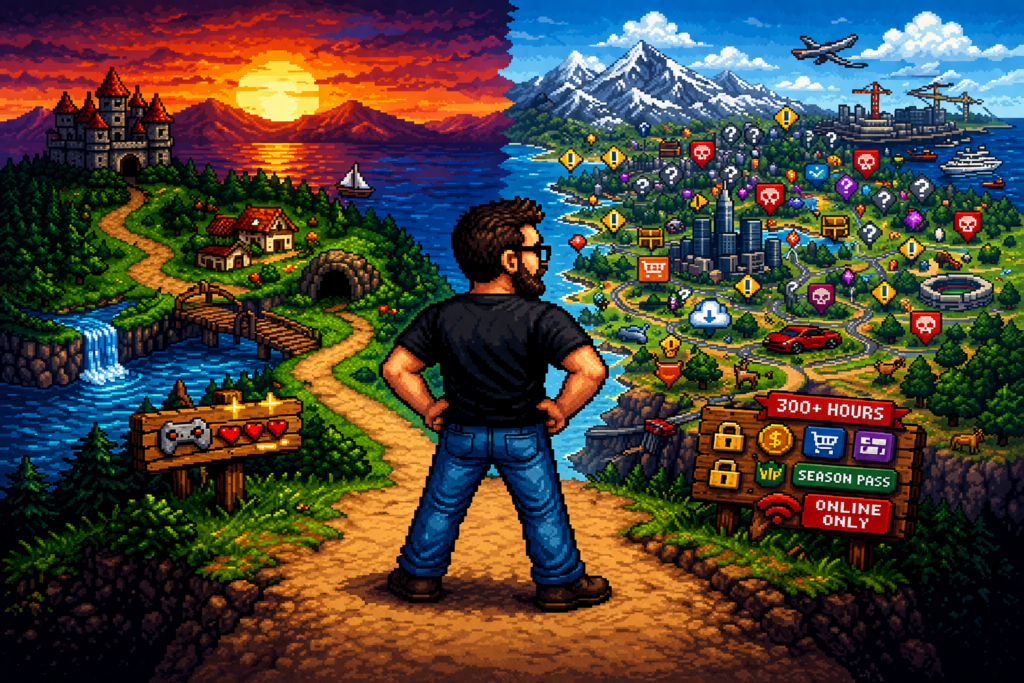
This is one of the biggest sins in modern gaming.
Everything has to be bigger now. Bigger world. More quests. More systems. More gear. More crafting. More dialogue. More content. More icons on the map. More freedom. More everything. It sounds impressive until you realize most of it is fluff, filler, and repetition with better marketing.
Older games did not have that option.
They had to condense themselves. They had to make every area pull its weight. Every weapon mattered more. Every sound effect had to count. Every enemy had to be readable. Their identity had to be stronger because they could not bury you under fifty hours of side activity until your standards gave up and died.
That is why so many older games still feel specific.
You remember the menus.
You remember the soundtrack.
You remember the weird sound a door made.
You remember a hallway.
A boss arena.
A weapon reload.
A stupid jump that ruined your evening.
A level that made you feel something.
Compare that to a lot of modern giant games. You finish them and six months later all you remember is some crafting, some map-clearing, some sad people mumbling in cutscenes, and a skill tree full of upgrades so minor they should legally count as administrative errors.
Big is not the same as memorable.
A short game with strong identity will outlive a huge game packed with filler every single time. Humans love excess because it photographs well on store pages, but excess without purpose is just bloat wearing expensive shoes.
Older Games Felt Like Things, Not Services
This one gets depressing fast.
An older game felt like a thing. You bought it. You owned it. You played it. Maybe it had flaws, maybe it crashed sometimes, maybe it had the occasional weird bug, but it was a whole object. Self-contained. Real.
Now half the industry feels like renting access to a mood disorder.
Online check. Account required. launcher needed. day-one patch. premium edition bonus. timed events. server dependency. store integration. future support roadmap. “We thank the community for the journey” posted three years later when the servers get shut down and your purchase quietly turns into a memory.
That changes the emotional weight of games.
Older games felt anchored. They belonged to a machine, a room, a certain period in your life. Modern games often feel temporary even when they are huge. They feel managed. Maintained. Monetized. They do not feel like finished experiences as often. They feel like products being operated.
And once a game starts feeling like a product first, something important dies inside it.
The games that stay with people usually have shape. They start, they build, they end, and they leave something behind. They do not just sit there demanding recurring engagement like a needy app.
Older games wanted to be remembered.
Modern games too often want to make sure you log in tomorrow.
That is not the same ambition.
Limits Gave Older Games More Personality
This might be the biggest reason older games still hit so hard.
Limits force decisions.
When you cannot do everything, you have to choose what matters. That creates identity. Style. Personality. Older games had technical limits all over them, but those limits often sharpened the result. They had to commit to something.
When you cannot compete on realism, you lean on art direction.
When you cannot make the world huge, you make it memorable.
When you cannot stuff it with systems, you make the core stronger.
That is why so many older games still feel alive. They were allowed to be weird. Allowed to be specific. Allowed to be difficult. Allowed to have rough edges and bizarre choices and bold moods. Modern AAA design often sands all that down so the final product can appeal to everyone, offend nobody, and be safely monetized by people who probably think “player expression” means a costume pack.
The result is often polished, expensive, competent, and forgettable.
Competent is nice.
Competent is not enough.
A lot of older games were messy, but they had blood in them. They had pulse. They felt made, not assembled. Even when they were rough, they were rough in a way that belonged to them.
That matters more than people think.
The Best Modern Games Still Win the Old Way
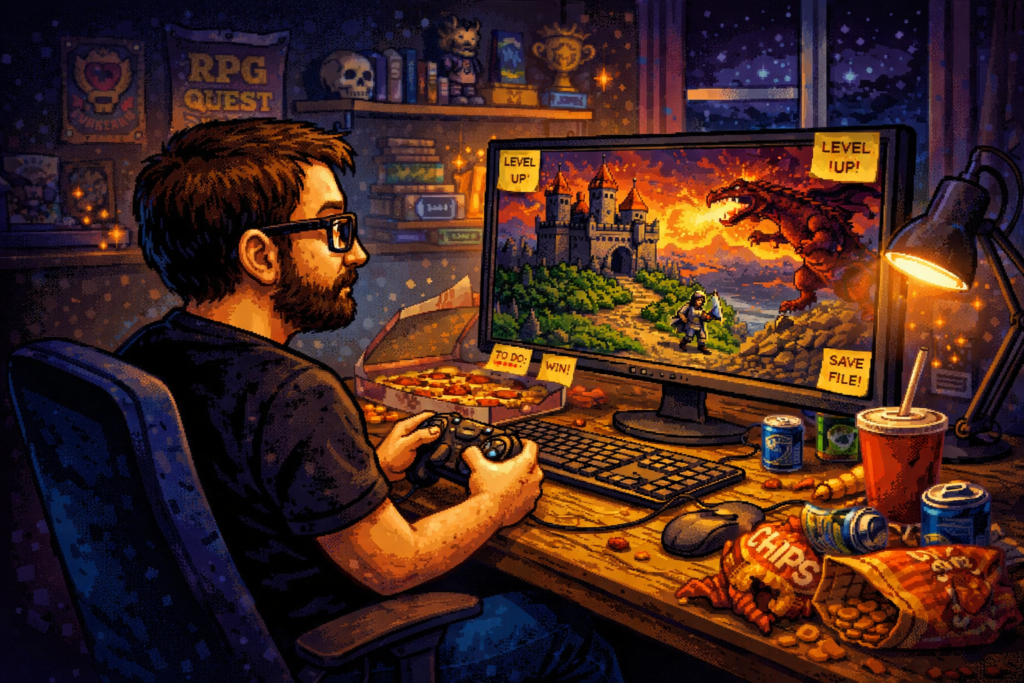
To keep this honest, not every modern game is some bloated content farm in a trench coat. Some modern games are fantastic. Some absolutely hit hard.
But notice what the best ones usually do.
They focus.
They cut the fat.
They trust the player more.
They build atmosphere instead of drowning it in noise.
They care about pacing.
They have real identity.
They stop trying to occupy your entire life and instead try to leave a mark on it.
In other words, the best modern games usually work because they remember lessons older games were forced to learn.
That is the irony.
Older games had discipline because they had no choice.
Modern games have to choose discipline on purpose.
A lot of them do not.
Older Games Hit Harder Because They Wanted to Leave a Scar
That is really the whole thing.
Older games were not always smoother. Not always fairer. Definitely not always more comfortable. But they were often tighter, stranger, meaner, more focused, and more willing to ask something from you. They had less room to waste, so more of what was there had to matter.
Modern games often want your time.
Older games often wanted your memory.
That is the difference.
One gives you retention metrics, content calendars, and eighty hours of padded nonsense.
The other gives you a boss fight you still remember ten years later.
A menu theme that still lives in your head.
A level that felt oppressive in a way modern technology still cannot recreate.
A weird mechanic you hated then but respect now.
A feeling that stuck.
That is why older games hit harder.
Not because we were children.
Not because every old game was better.
Not because modern games are doomed.
Because older games, at their best, were built to leave a mark.
Modern games, far too often, are built to make sure you come back tomorrow.
This version sounds a lot closer to an actual human with opinions instead of a polished appliance pretending to have a soul.
Hey! You wanna know what also hit hard? FPS GAMES! Read this: Back when FPS Games actually Slapped!