I use AI. Quite a lot, actually. I use it to build software, work through problems, and make things that I wanted badly enough to stop waiting for someone else to make them properly. I know what it can do for one person with an idea and a limited budget.
I can appreciate all of that and still look at what is happening around gaming and think: what the fuck are we doing?
Because the AI boom reaches further than the artwork in a game. It affects the companies making the hardware, the people creating the games, and the decisions about what we are supposed to spend our money and time on.
And somewhere in all the excitement about producing more things more efficiently, I would like someone to explain what the player is getting.
Your next upgrade has a more important customer
You can avoid every chatbot on the planet. You can refuse to buy games with generated artwork. You can have absolutely no interest in AI.
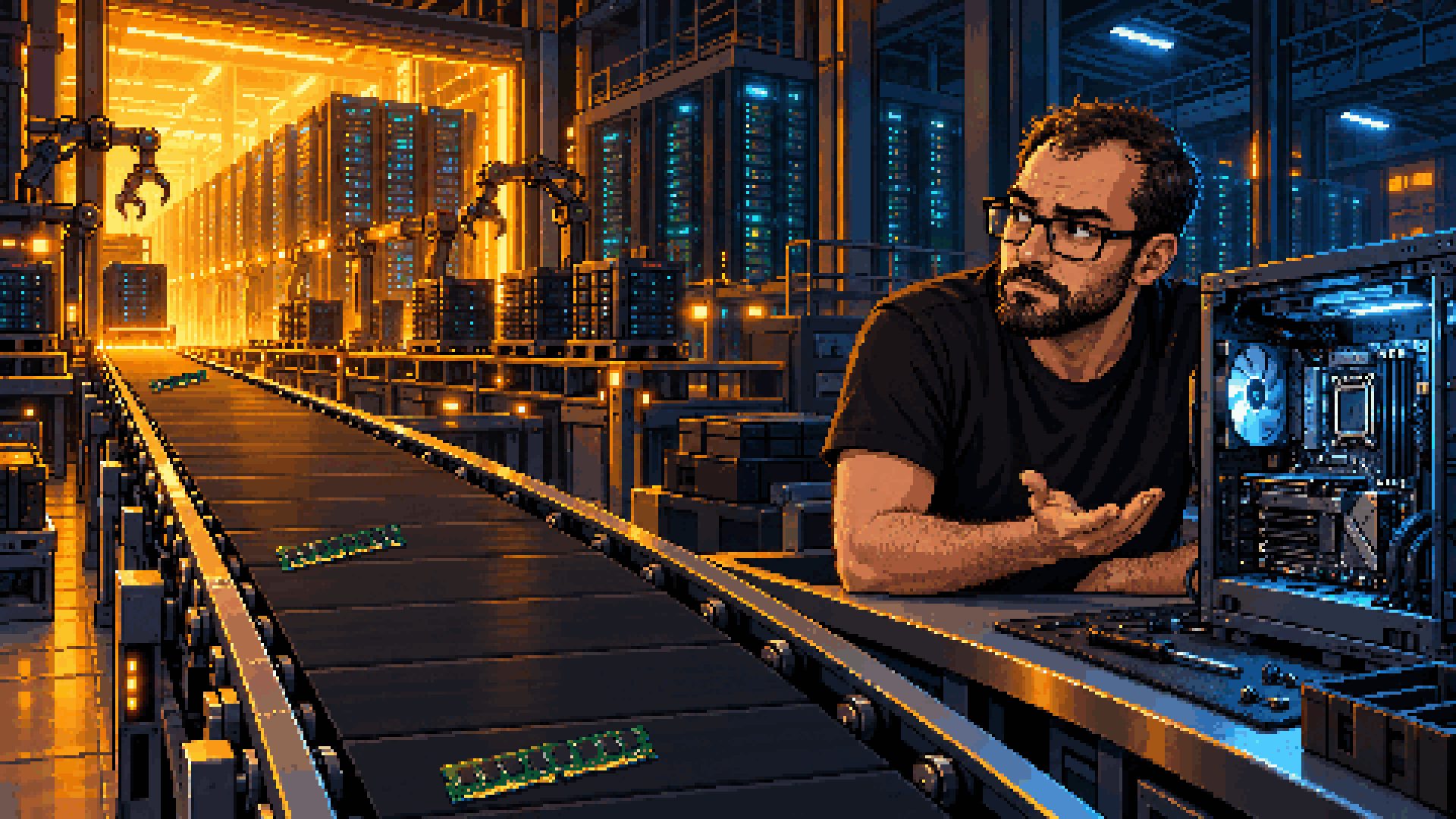
The company making the RAM for your next PC can still decide that the AI business deserves more of its attention.
In December 2025, Micron announced that it was exiting the Crucial consumer business, with consumer shipments continuing through February 2026. The company explicitly connected the decision to AI data center demand and improving supply for larger strategic customers.
That is a fairly direct explanation of where its priorities were going.
Micron’s fiscal 2026 annual report also says AI demand for memory and storage was growing faster than industry supply. It describes supply allocation decisions and says strong demand, combined with constrained supply, increased DRAM and NAND pricing across its portfolio.
So yes, AI can affect your gaming upgrade before you install a single game.
That does not tell us exactly how much of a particular RAM kit’s price comes from AI demand. Micron also continues to supply components used by other manufacturers. The point is that a major supplier has openly described the pressure and its response to it.
As someone who buys hardware to actually use the damn thing, I find that annoying enough without inventing a conspiracy.
I understand why a company chases customers placing enormous orders. I am also perfectly entitled to dislike becoming a less important customer.
A decision can make wonderful business sense and still make my hobby worse.
Faster to produce had better mean something for the player

Inside the games themselves, I have a fairly simple question.
If AI makes part of production easier, where does that benefit go?
Call of Duty’s Steam disclosure acknowledges using generative AI tools to help develop some in-game assets. It does not identify every affected asset or tell us how much human work went into the finished results.
Fine. Then the finished results are what we should judge.
If a tool saves time, use that time to improve the game. Give the artists room to refine things. Let the writers fix the scenes that aren’t working. Spend more effort on the boring problems that players actually notice after buying the thing.
My concern is that a manager can look at the same time saving and decide that everyone should simply produce twice as much.
Congratulations, we now have more content. Is any of it better?
I don’t receive a copy of the development spreadsheet when I buy a game. I receive the game. Whatever clever process happened behind the scenes needs to amount to something I can experience.
And if the result feels careless, explaining that it was efficient to make is a spectacularly shit defense.
Infinite content sounds like a fucking threat

I have a job, a wife, a child, and other things I want to do with my life. My available gaming time is already limited.
So when I hear about the possibility of endless quests and conversations, my first reaction is to wonder how much of that I would actually want to play.
Give an NPC ten thousand possible responses if you want. I still need a reason to care what they say. A character can talk forever and remain completely forgettable.
The same goes for quests. Change the name of the village, generate a different excuse, and send me to collect another object. Technically, you have produced something new. From where I am sitting, I may be doing the same fucking errand.
I would rather have a small number of quests that someone cared enough to make interesting. Let a decision matter. Let me discover something because I was curious. Give me a reason to remember the place after I leave it.
There is room for generated material in that process. Games can do interesting things with systems and variation. Someone still has to decide what those systems are for and whether the results are worth keeping.
That last part matters more as generation gets easier.
If producing another hundred lines becomes cheap, someone needs the judgment to throw away ninety-five of them. Otherwise, the player becomes the person sifting through trash that nobody bothered to cut.
I already have enough shit to sift through. That is part of why I wanted to play a game, not work as an intern for a video game company, as a tester.
The people making this stuff deserve a say
There is also a human side to this that gets frustratingly easy to discuss as if everyone involved were a production expense.
A voice actor’s performance is their work. If a studio wants to generate more material using a digital version of that performance, the person should understand the arrangement, have a meaningful choice, and be paid appropriately.
That concern has already reached contract negotiations. SAG-AFTRA’s ratified 2025 video game agreement included consent and disclosure requirements for AI digital replica use. Those are protections under that agreement, rather than a universal rule covering every game.
I find it entirely reasonable that people want control over what happens to their own performances.
The same concern applies more broadly to what happens inside a studio. If a tool helps an artist finish a tedious task, great. If the response is to remove the artist’s job and expect someone else to clean up whatever the tool produces, I want to know what has actually improved.
And if the entry-level work disappears, where are the experienced people supposed to come from later?
You don’t get a senior developer by typing “senior” into a job ad and waiting for one to just appear out of thin air. People become good at things by actually doing them, making mistakes, and learning from people who know more, probably my making more mistakes, or different ones.
GDC’s 2026 survey found that 52% of responding game industry professionals viewed generative AI’s impact on the industry negatively, while 36% reported using it in their work. Those are separate figures, and the survey measures opinions rather than proving what caused any particular layoff.
Still, the concern deserves a hearing. People working in an industry are allowed to question a technology being brought into their workplaces, including when they use it themselves.
Using AI means taking responsibility for the result

This applies to me as well.
If I use AI to help build an application and the application is broken, the person using it still has a broken application. They shouldn’t have to give a shit which part I wrote, which part the tool suggested, or how impressive the development process felt.
I chose to put the thing in their hands. I have to test it, fix it, and listen when something is wrong.
That is the standard I want applied to games.
A small developer can use AI to attempt something they could never have afforded otherwise. I understand that appeal very well. A large studio can also use a tool sensibly. The quality of the result, the decisions behind it, and the treatment of the people involved still matter in both cases.
Having a small budget doesn’t make careless work good. Having a large budget doesn’t make every use of automation bad.
What bothers me is being expected to lower my standards because the process has changed.
I still want art that fits the game. I still want dialogue that somebody checked. I would like the game to work properly on the hardware it claims to support. And I definitely would like the games to be better optimized since it’s easier to code now more than ever.
The presence of AI doesn’t reduce any of those expectations.
Show me the benefit

There are uses of AI in gaming that I can get behind. Help a developer investigate a stubborn bug. Make a tool easier to use. Help a small team test an idea while they still have time to change it.
Then show me what improved.
If the benefit is more time to polish the game, I should be able to see the polish. If it allows a game to exist that otherwise couldn’t, let the game make its case. If the result is a better experience at a fair price, I can judge that for myself.
What I am considerably less enthusiastic about is consumer hardware becoming a lower priority while game production becomes increasingly focused on how much material can be pushed through it.
I want to be able to afford the machine, enjoy what I play on it, and feel that the people selling it respected the time and money I gave them.
And since AI is really changing the scene, we should actually expect better results than before. Companies should attempt some of those arcane ideas that always roamed the studios and never happened due to technical limitations. AI is the best thing we have got to this far, and companies are hellbent on using it, fine by me, show me you can do better with better tech, not how cheap you can go or how much worse it can get.
That seems like a pretty reasonable expectation from a hobby that I am paying a pile of money for.
So, by all means, tell me how much faster AI made your production process. Tell me about the possibilities and innovation. I use the stuff. I know it can be useful.
Then explain why I should be happy about the result.
If AI is supposed to make everything faster, cheaper, and easier to produce, when does the player actually get a better deal?